

Jason Bourne is the owner of a Fremont-based water restoration business, dedicated to helping homeowners and businesses recover quickly from water damage. With a focus on reliable service, fast response times, and quality restoration work, Jason is committed to helping clients restore their properties and get back to normal.
Water damage is responsible for billions of dollars in property losses across the United States each year — and a significant portion of that damage goes undetected until it becomes a costly structural problem. If you’re a Castro Valley homeowner, knowing the 5 signs your Castro Valley home has hidden water damage could mean the difference between a straightforward repair and a major restoration project.
Hidden water damage rarely announces itself. It develops quietly inside walls, beneath floors, and above ceilings — often for weeks or months before a homeowner notices anything wrong. The good news is that there are clear, identifiable warning signs that can alert you early.
Key Takeaways
- Hidden water damage often develops long before visible symptoms appear
- Musty odors, stained surfaces, warped materials, and unexplained utility spikes are all red flags
- Castro Valley’s climate and older housing stock make homes particularly susceptible
- Mold can begin growing within 24 to 48 hours of water exposure
- Professional moisture testing is the only reliable way to confirm hidden damage
- Early detection dramatically reduces repair costs and health risks
- Fremont Restoration Experts provides 24/7 emergency response for water damage situations in Castro Valley and surrounding areas
What Are the 5 Signs Your Castro Valley Home Has Hidden Water Damage?
The five most reliable indicators of concealed water damage are: persistent musty odors, discoloration or staining on walls and ceilings, warped or buckling floors, an unexplained increase in your water bill, and visible mold growth. Each of these signs points to moisture accumulating in places you cannot easily see — and each warrants prompt professional evaluation.
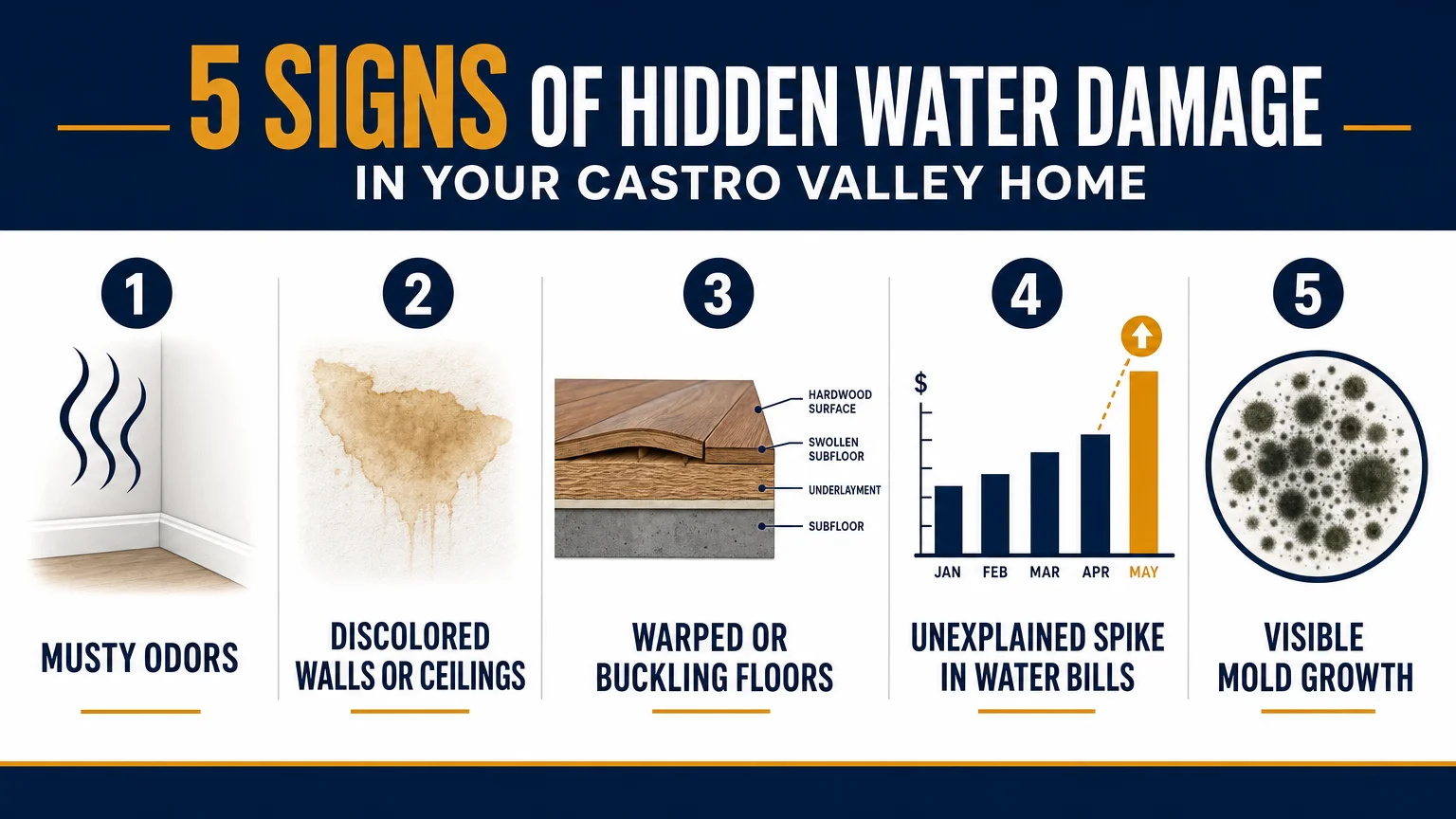
Castro Valley sits in a microclimate that combines coastal fog, seasonal rainfall, and warm summers — conditions that create an environment where moisture intrusion is a recurring challenge for homeowners. Older homes in the area, many built in the mid-20th century, often have aging plumbing, original roofing materials, and minimal vapor barriers, all of which increase vulnerability to hidden leaks.
Sign 1: Persistent Musty or Earthy Odors
A musty smell inside your home is one of the earliest and most consistent indicators of hidden moisture. That distinctive earthy odor is produced by microbial volatile organic compounds (MVOCs) — gases released by mold and mildew as they consume organic materials like wood, drywall, and insulation.
If you notice the smell intensifying in a specific room, near a particular wall, or after running water, that localization is diagnostically important. It suggests the moisture source is nearby. Many homeowners mistakenly attribute this odor to age or poor ventilation, masking the symptom rather than addressing the underlying cause. If standard cleaning and airing out do not eliminate the smell within a few days, a professional moisture inspection is warranted.
Sign 2: Discoloration, Staining, or Bubbling on Walls and Ceilings
Yellow, brown, or rust-colored stains on drywall or plaster are classic evidence of water migration. These stains form when water carries dissolved minerals, rust particles, or organic compounds through building materials and deposits them on the surface as it evaporates.
Pay particular attention to:
- Ring-shaped stains — indicate a slow, recurring leak rather than a one-time event
- Bubbling or peeling paint — moisture trapped beneath the surface breaks the bond between paint and substrate
- Soft or spongy drywall — pressing gently on a stained area and feeling give or flex suggests significant saturation
- Ceiling stains directly below a bathroom — a strong indicator of a slow drain or supply line leak above
Staining alone does not tell you how much water is present or how far it has spread. A moisture meter in the hands of an experienced technician can map the full extent of saturation — often revealing that damage extends well beyond the visible stain.
Sign 3: Warped, Buckling, or Soft Flooring
Flooring materials are highly sensitive to moisture. Hardwood expands when it absorbs water, causing boards to cup, crown, or buckle. Laminate flooring swells at the seams. Vinyl may lift or bubble. Even tile floors can signal a problem — when grout lines crack or individual tiles become loose without obvious physical impact, moisture beneath the subfloor is often the culprit.
A particularly telling scenario is soft spots in the floor. If walking across a hardwood or tile floor produces a springy or hollow sensation underfoot, the subfloor beneath may have deteriorated due to prolonged moisture exposure. This type of structural damage is expensive to remediate if left unaddressed. Structural drying performed early — before subfloor materials fully saturate — is far less invasive and costly than full subfloor replacement.
Sign 4: An Unexplained Increase in Your Water Bill
A sudden or gradual spike in your monthly water usage that cannot be explained by seasonal changes or new appliances is a strong indicator of a hidden leak. Even a small, slow leak — one that drips at a rate that would never be noticed by sound or sight — can waste hundreds of gallons per month and cause significant cumulative damage to surrounding materials.
How to perform a basic leak check at home:
- Turn off all water-using appliances and fixtures in the home
- Locate your water meter and note the current reading
- Do not use any water for 30 to 60 minutes
- Return to the meter — if the reading has changed, water is moving somewhere in your system
This simple test does not identify the source or location of the leak, but it confirms that one exists. At that point, contacting a professional for a thorough inspection is the appropriate next step. Fremont Restoration Experts is available 24/7 for emergency water extraction in Fremont and throughout Castro Valley.
Sign 5: Visible Mold Growth — Even in Small Amounts
Mold growth is the most definitive visible sign that moisture has been present long enough and in sufficient quantity to support biological activity. Mold can begin colonizing porous materials within 24 to 48 hours of water exposure under the right temperature and humidity conditions — and Castro Valley’s climate provides those conditions regularly.
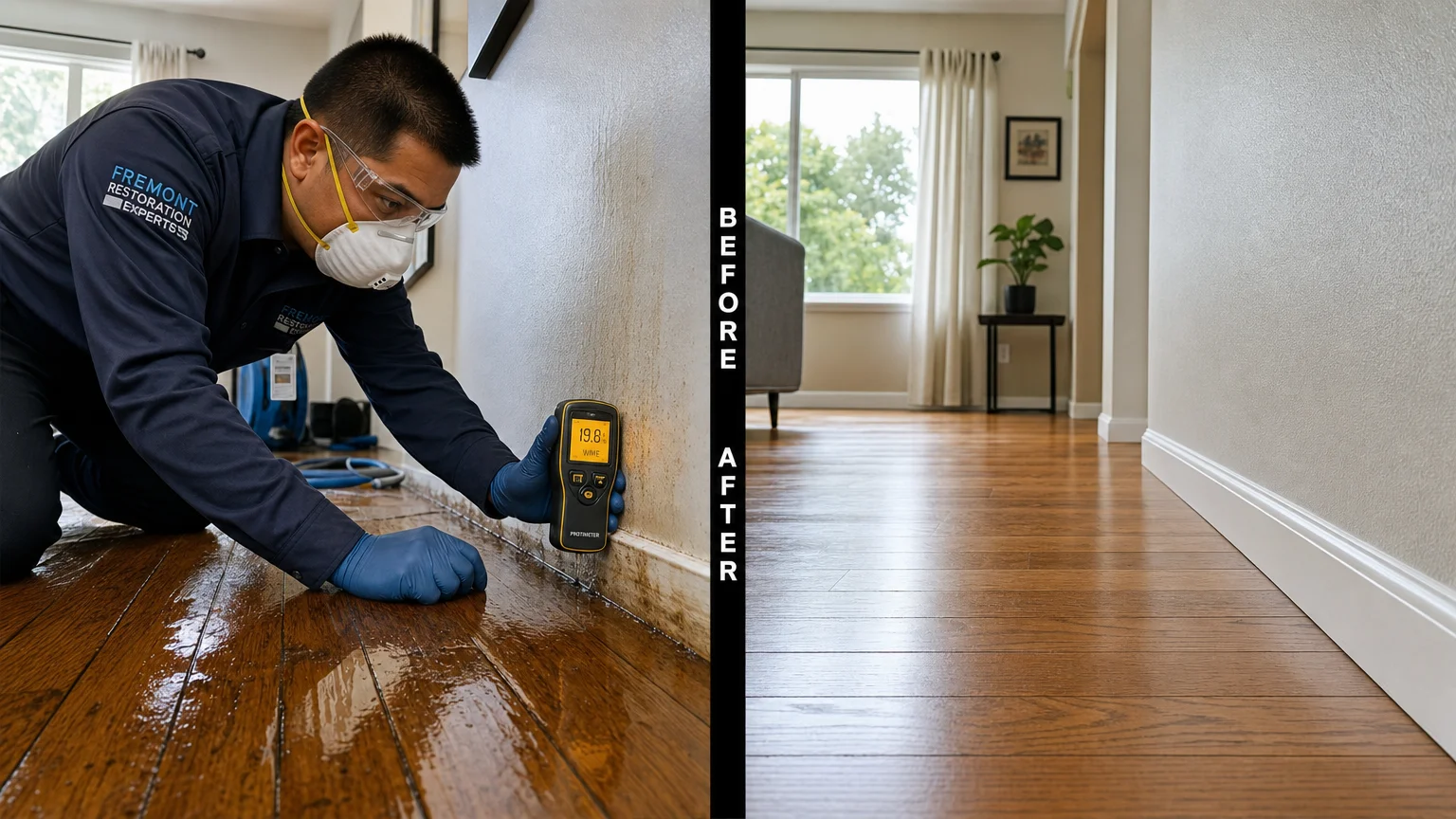
Mold does not always appear as the dramatic black patches depicted in media coverage. It frequently presents as:
- Small gray or green clusters near window frames or in corners
- White or powdery growth on basement walls or crawlspace framing
- Dark streaking along caulk lines in bathrooms or kitchens
- Fuzzy growth on the back side of furniture pushed against exterior walls
Even a small visible colony indicates a larger hidden population. Mold grows primarily where moisture is highest — which is almost always inside walls, under floors, or above ceiling tiles rather than on open surfaces. A professional mold inspection in Fremont or Castro Valley can identify the full scope of colonization using air sampling and surface testing. If remediation is needed, mold remediation in Castro Valley should be performed by certified professionals to ensure complete removal and prevent recurrence.
How Do These Signs Compare? A Quick Reference Checklist
| Warning Sign | What It Looks/Feels/Smells Like | Urgency Level |
|---|---|---|
| Musty odor | Earthy, damp smell — often worse in one area | Moderate — inspect within days |
| Wall/ceiling stains | Yellow, brown, or rust-colored patches | Moderate-High — source must be found |
| Warped or soft flooring | Buckling, cupping, springy underfoot | High — subfloor damage may be active |
| Elevated water bill | Unexplained usage increase | High — active leak likely present |
| Visible mold | Spots, streaks, or fuzzy growth on surfaces | Immediate — remediation required |
When Should Castro Valley Homeowners Call a Professional?
Any single sign from the list above justifies a professional evaluation — and the presence of two or more signs simultaneously makes professional assessment urgent. DIY moisture detection has real limitations: consumer-grade moisture meters often cannot penetrate deep enough into wall cavities to detect saturation at the framing level, and visual inspection alone misses the majority of hidden damage.
Fremont Restoration Experts serves Castro Valley homeowners with comprehensive water damage assessment, structural drying, water damage repair, and mold remediation. The team is available around the clock for emergency situations — because water damage does not wait for business hours.
If you’re uncertain whether what you’re seeing qualifies as a problem, reviewing common questions on the FAQ page is a useful starting point before scheduling an inspection.
Take Action Before Hidden Damage Becomes a Major Problem
The 5 signs your Castro Valley home has hidden water damage — musty odors, staining, warped flooring, elevated water bills, and visible mold — are your home’s way of communicating that something is wrong beneath the surface. Addressing these signs early is always less expensive, less disruptive, and less hazardous than waiting until damage becomes impossible to ignore.
Fremont Restoration Experts provides professional water damage assessment, structural drying, and mold remediation services to Castro Valley homeowners and throughout the greater Fremont area. If you’ve noticed any of the warning signs described in this article, contact the team today for a professional evaluation. Emergency response is available 24 hours a day, 7 days a week.
Frequently Asked Questions
How quickly does hidden water damage become serious?
Water damage can become structurally significant within days. Mold can begin growing within 24 to 48 hours of exposure, and wood framing can begin to soften and lose structural integrity within a week of sustained saturation. The faster damage is identified and dried, the less extensive the repair.
Can I detect hidden water damage myself without professional tools?
Homeowners can identify surface-level signs — stains, odors, warped flooring — without specialized equipment. However, confirming the extent and location of hidden moisture inside walls or under floors requires professional-grade moisture meters and thermal imaging cameras that most homeowners do not have access to.
Does homeowner's insurance cover hidden water damage in Castro Valley?
Coverage depends on the cause and your specific policy. Sudden and accidental damage — such as a burst pipe — is typically covered. Gradual damage from a slow, long-term leak is often excluded. Documenting the damage promptly and contacting your insurer quickly improves your chances of a favorable outcome.
What causes hidden water damage in Castro Valley homes specifically?
Castro Valley homes face risks from aging plumbing infrastructure, roof wear from seasonal rain, inadequate attic ventilation that leads to condensation, and foundation moisture from the area's clay-heavy soils. Older homes built before modern moisture barrier standards are particularly susceptible.
Is mold always present with hidden water damage?
Not always — but mold becomes likely when moisture has been present for more than 24 to 48 hours in warm conditions. Castro Valley's climate means that even brief water intrusion events can trigger mold growth if materials are not dried promptly and thoroughly.
What is structural drying and why does it matter?
Structural drying is the professional process of removing moisture from building materials — walls, floors, framing, and subfloors — using industrial dehumidifiers, air movers, and monitoring equipment. It prevents secondary damage such as mold growth, wood rot, and structural weakening that occurs when materials remain wet after the visible water is removed.
How do I find the source of a water leak if I can't see it?
Professional restoration technicians use thermal imaging cameras to detect temperature differentials caused by moisture behind walls and under floors. Moisture meters provide quantitative readings at multiple points to map the spread of water. These tools allow technicians to locate the source without unnecessary demolition.
Jason Bourne is the owner of a Fremont-based water restoration business, dedicated to helping homeowners and businesses recover quickly from water damage. With a focus on reliable service, fast response times, and quality restoration work, Jason is committed to helping clients restore their properties and get back to normal.