

Jason Bourne is the owner of a Fremont-based water restoration business, dedicated to helping homeowners and businesses recover quickly from water damage. With a focus on reliable service, fast response times, and quality restoration work, Jason is committed to helping clients restore their properties and get back to normal.
Water damage affects roughly 14,000 U.S. homes and businesses every single day, according to the Insurance Information Institute. When a pipe bursts or a flood soaks your floors in Fremont, the instinct is often to grab fans and towels and handle it yourself. But the real question — the one that determines your total out-of-pocket cost — is whether DIY drying vs. professional structural drying actually saves you money in the long run. The short answer: professional structural drying almost always costs less when you account for secondary damage, mold remediation, and structural repairs that follow incomplete drying.
Key Takeaways
- DIY drying methods like box fans and wet-vacs rarely reach moisture trapped inside walls, subfloors, and structural cavities.
- Incomplete drying creates conditions for mold growth within 24–72 hours of water exposure.
- Professional structural drying uses industrial-grade equipment and moisture mapping to verify dryness at a structural level.
- The upfront cost of professional drying is typically offset by avoiding mold remediation and structural repair bills.
- Fremont’s Bay Area climate — with its moderate humidity — slows natural evaporation, making professional drying equipment especially valuable.
- Insurance claims are better supported when a certified restoration company documents the drying process.
- Homeowners in Fremont, Newark, San Lorenzo, Union City, and Milpitas have access to 24/7 emergency structural drying services.
What Is the Actual Difference Between DIY and Professional Structural Drying?
The core difference is depth. DIY drying addresses surface moisture — the water you can see and feel. Professional structural drying addresses moisture inside building materials: drywall, insulation, wood framing, concrete subfloors, and wall cavities. When water infiltrates these materials, surface evaporation from a box fan does nothing to remove it. Professionals use industrial air movers, low-grain refrigerant (LGR) dehumidifiers, and thermal imaging cameras to locate and eliminate moisture at every layer of the structure.
A standard residential box fan moves roughly 2,000 cubic feet of air per minute (CFM). A single professional air mover used in structural drying moves 1,500–3,000 CFM but is positioned at precise angles to create a vortex effect along wall surfaces — a technique called the “air vortex drying method” — that draws moisture out of porous materials far more efficiently than a fan pointed at the floor.
How Do the Real Costs Compare Between DIY Drying and Professional Structural Drying?
Cost is where the DIY vs. professional structural drying debate becomes clearest. The upfront numbers favor DIY — a wet-vac rental, some fans, and a few days of effort. But the downstream costs tell a different story.
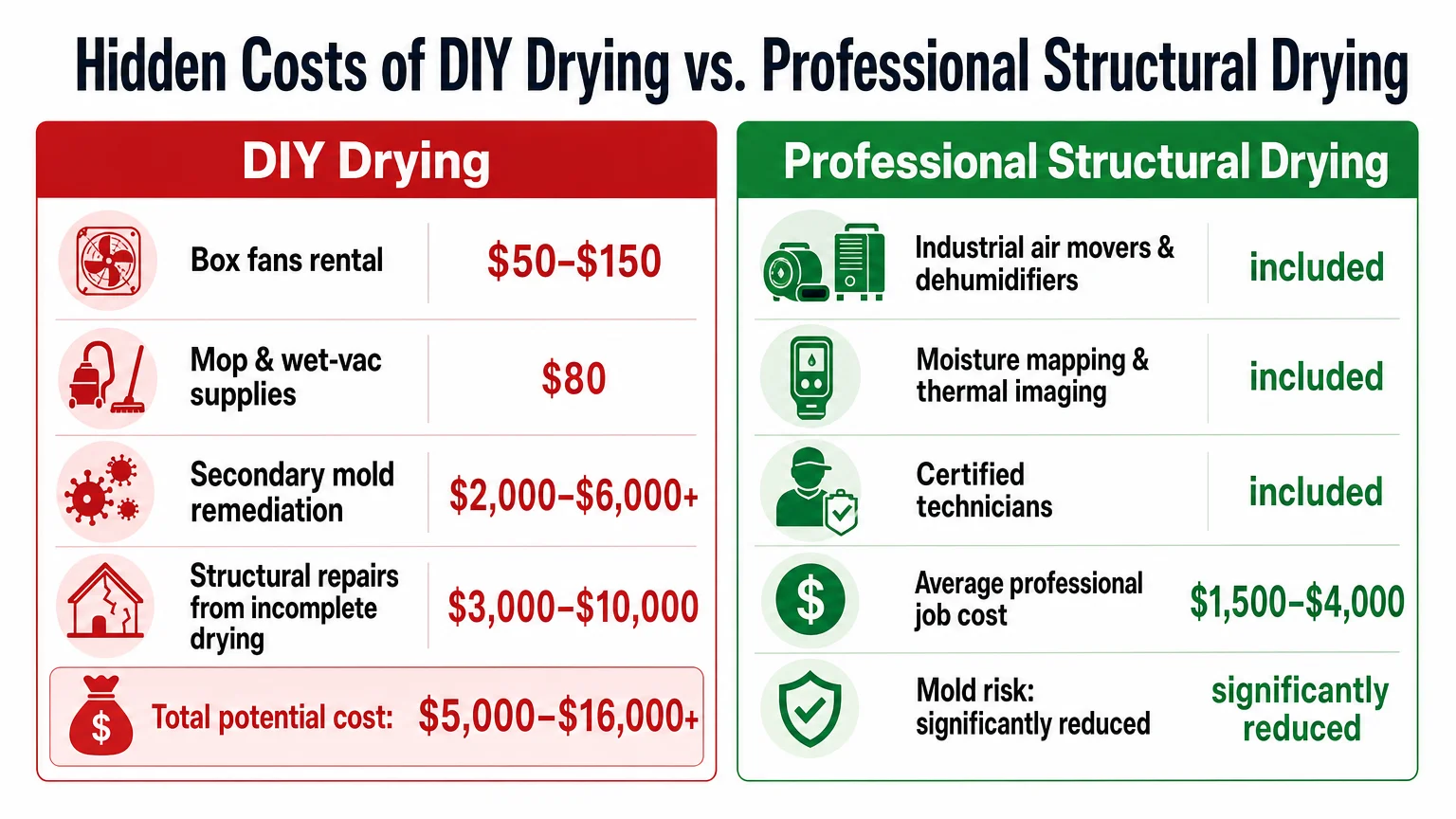
Here is a realistic cost breakdown for a moderate water damage event (e.g., a burst pipe affecting one bathroom and an adjacent bedroom):
| Cost Category | DIY Drying | Professional Structural Drying |
|---|---|---|
| Equipment (fans, wet-vac) | $50–$200 | Included in service |
| Labor (your time, ~20+ hours) | Unpaid but real | Handled by certified technicians |
| Moisture testing/verification | None | Included (thermal imaging, meters) |
| Mold remediation if drying fails | $2,000–$6,000+ | Significantly reduced risk |
| Structural repairs from hidden moisture | $3,000–$10,000+ | Significantly reduced risk |
| Professional drying service cost | — | $1,500–$4,000 (typical range) |
| Realistic total exposure | $5,000–$16,000+ | $1,500–$4,000 |
The math is not subtle. A homeowner who spends $150 on fans and misses moisture in the wall cavity may face a $4,000 mold remediation bill three weeks later — on top of the original damage. If you’re dealing with water damage in the San Lorenzo or Union City area, Water Damage Restoration in San Lorenzo and Emergency Water Extraction in Union City are available around the clock to prevent exactly this scenario.
Why Does Incomplete DIY Drying Lead to Mold Growth?
Mold spores are present in virtually every indoor environment. They need only three things to colonize: moisture, a food source (drywall paper, wood), and temperatures above 40°F. When DIY drying leaves residual moisture inside walls or under flooring, mold can establish colonies within 24–72 hours — often invisible until it has spread significantly.
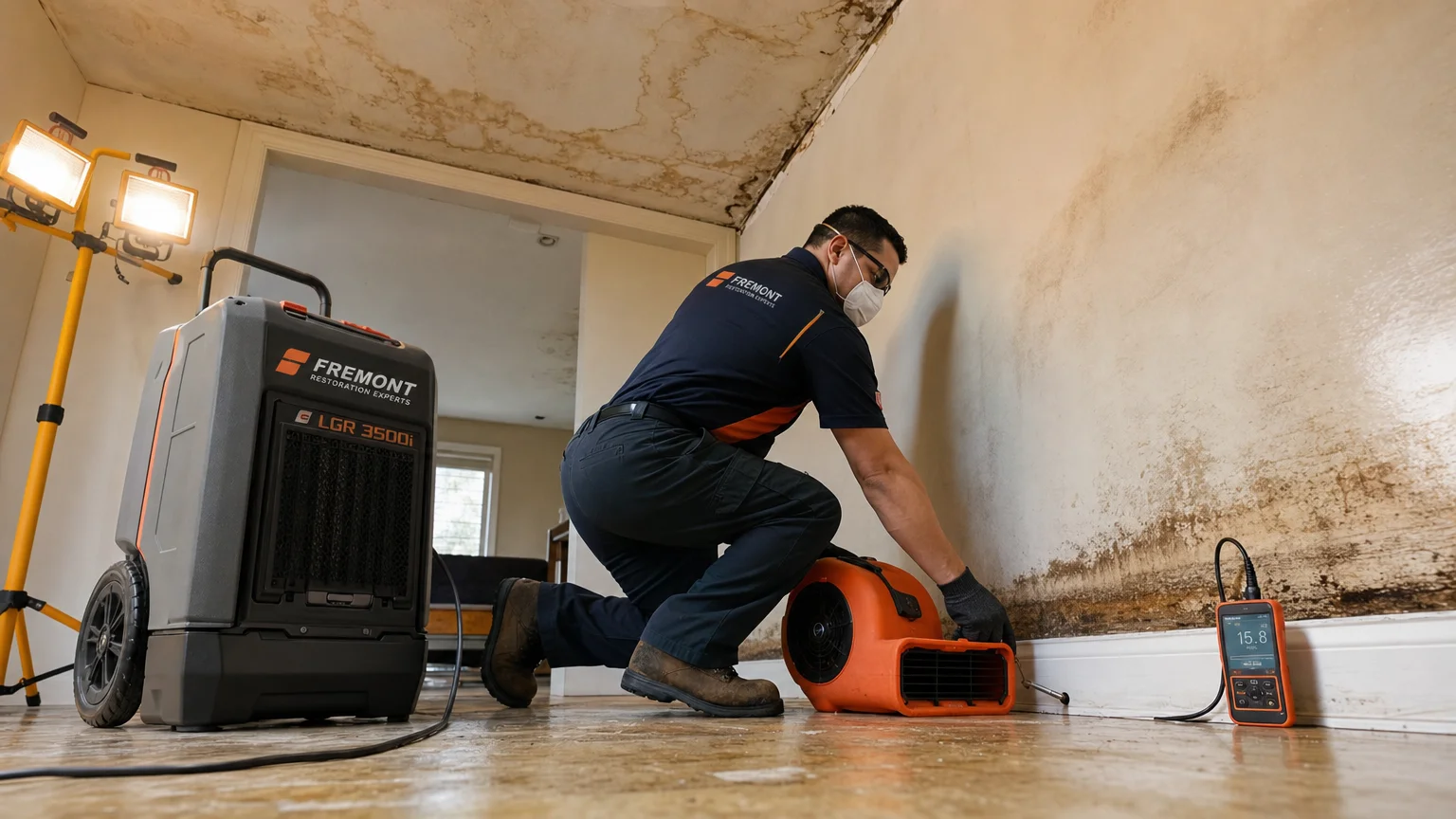
The Bay Area’s moderate humidity (Fremont averages around 60–70% relative humidity year-round) means that even after visible water is removed, ambient moisture in the air slows natural evaporation dramatically. Professional dehumidifiers pull moisture directly from the air and from within materials, driving relative humidity down to levels where mold cannot survive. Without that equipment, a “dried” room may still hold enough moisture in its structural materials to sustain mold growth for months.
If mold does establish itself following incomplete drying, the remediation process is substantially more disruptive and expensive than the original drying job. For homeowners in Milpitas or Newark, Mold Remediation in Milpitas and Mold Inspection in Newark provide professional assessments to catch problems early before they escalate.
What Equipment Do Professionals Use That Homeowners Cannot Easily Access?
Professional structural drying relies on a suite of equipment that is rarely available at consumer rental centers — and even when available, requires training to deploy correctly:
- LGR Dehumidifiers: Low-grain refrigerant dehumidifiers remove far more moisture per kilowatt-hour than consumer units, capable of extracting 100+ pints per day in a contained space.
- Axial and Centrifugal Air Movers: Positioned at precise angles to walls and floors to maximize drying of structural materials, not just air.
- Thermal Imaging Cameras: Detect temperature differentials in walls and ceilings that reveal hidden moisture pockets invisible to the naked eye.
- Moisture Meters and Hygrometers: Provide quantitative readings of moisture content in wood, drywall, and concrete — the only way to verify structural dryness.
- Negative Air Machines / HEPA Air Scrubbers: Contain airborne mold spores and contaminants during the drying process.
This equipment, combined with the expertise to interpret readings and adjust drying strategies, is what separates a verified dry structure from one that merely looks dry. For residents in Newark who want this level of precision, Structural Drying in Newark delivers exactly this approach.
Does Homeowner’s Insurance Cover Professional Structural Drying?
In most cases, yes — provided the water damage is from a sudden and accidental event (burst pipe, appliance leak, storm intrusion) rather than gradual neglect. Most standard homeowner’s insurance policies in California cover the cost of professional water damage restoration, including structural drying, as part of the covered loss.
Critically, professional restoration companies document the entire drying process with moisture logs, equipment readings, and photographic evidence. This documentation is essential when filing a claim. DIY drying produces no such documentation, which can complicate or reduce insurance payouts. Insurance adjusters are trained to look for evidence of proper mitigation — professional drying records provide that evidence; a receipt for box fans does not.
When Is DIY Drying Ever Acceptable?
DIY drying is appropriate in a narrow set of circumstances: very small, contained spills on non-porous surfaces (tile, sealed concrete) that are fully cleaned and dried within a few hours. If a glass of water spills on a tile floor and is mopped up immediately, no professional intervention is needed.
The threshold shifts the moment water contacts:
- Drywall or plaster
- Wood flooring or subfloor
- Carpet and padding
- Insulation inside walls
- Any area larger than roughly 10 square feet
Once any of these materials are involved, the risk of hidden moisture retention makes professional assessment the financially sound choice — not just the cautious one.
How Quickly Should You Act After Water Damage?
Speed is the single most important variable in water damage outcomes. Every hour of delay allows water to migrate further into structural materials and increases the likelihood of mold colonization. The general timeline:
- 0–2 hours: Water actively spreading; extraction and drying equipment should be deployed as quickly as possible.
- 2–24 hours: Drywall begins to swell and deteriorate; wood flooring starts to warp; mold risk begins.
- 24–72 hours: Mold can begin to colonize; structural materials may be compromised beyond drying alone.
- 72+ hours: Mold likely present; structural damage probable; remediation scope expands significantly.
Fremont Restoration Experts operates 24/7 for emergency water damage response throughout Fremont, Castro Valley, Milpitas, Newark, San Lorenzo, and Union City. For property owners in Union City or Milpitas who need immediate help, Property Damage Restoration in Union City and Property Damage Restoration in Milpitas are available at any hour.
Make the Decision That Protects Your Home and Your Budget
The DIY drying vs. professional structural drying question has a clear answer for most water damage scenarios: professional structural drying costs less over the full lifecycle of the loss. The upfront savings of a DIY approach routinely disappear when hidden moisture leads to mold remediation, structural repairs, or reduced insurance payouts.
Fremont Restoration Experts is available 24 hours a day, 7 days a week to respond to water damage emergencies throughout Fremont, Castro Valley, Milpitas, Newark, San Lorenzo, and Union City. If your home or business has experienced water damage — whether from a burst pipe, appliance failure, or storm intrusion — contact Fremont Restoration Experts for a professional assessment before attempting to dry the space yourself. Fast, certified response is the most cost-effective decision you can make.
Frequently Asked Questions
How much does professional structural drying typically cost in Fremont, CA?
Professional structural drying for a moderate water damage event in the Fremont area typically ranges from $1,500 to $4,000, depending on the affected area size, materials involved, and equipment required. This cost is frequently covered in full or in part by homeowner's insurance for qualifying sudden-loss events.
Can mold grow even if the floors look and feel dry?
Yes. Mold grows inside wall cavities, behind baseboards, and within subfloor materials where surface drying has no effect. A room can feel dry to the touch while retaining enough moisture in structural materials to sustain mold growth. Only moisture meter readings and thermal imaging can confirm true structural dryness.
How long does professional structural drying take?
Most residential structural drying projects take between 3 and 5 days, though larger losses or materials like concrete slabs may require longer. Professionals monitor moisture readings daily and adjust equipment placement until all materials reach target moisture content levels.
Will my homeowner's insurance cover the cost of professional drying?
Most California homeowner's insurance policies cover professional water damage restoration, including structural drying, for sudden and accidental water losses. Gradual leaks or maintenance-related damage are typically excluded. A professional restoration company can help document the loss for your claim.
What happens if I use DIY drying and it doesn't work completely?
Incomplete drying typically leads to mold growth within days to weeks, structural material deterioration, and potentially compromised air quality. Remediation at that stage is substantially more expensive than the original professional drying would have been, and insurance coverage for secondary damage from inadequate mitigation may be reduced.
Is professional structural drying available 24/7 in Fremont?
Yes. Fremont Restoration Experts provides 24/7 emergency water damage and structural drying services throughout Fremont and surrounding communities including Castro Valley, Milpitas, Newark, San Lorenzo, and Union City.
How do I know when structural drying is complete?
Drying is complete when moisture meter readings in all affected materials return to baseline levels appropriate for the material type and local climate conditions. Professionals provide documentation of these readings, which also serves as evidence for insurance purposes. Visual inspection alone is not a reliable indicator.
Jason Bourne is the owner of a Fremont-based water restoration business, dedicated to helping homeowners and businesses recover quickly from water damage. With a focus on reliable service, fast response times, and quality restoration work, Jason is committed to helping clients restore their properties and get back to normal.