

Jason Bourne is the owner of a Fremont-based water restoration business, dedicated to helping homeowners and businesses recover quickly from water damage. With a focus on reliable service, fast response times, and quality restoration work, Jason is committed to helping clients restore their properties and get back to normal.
Nearly 40% of homeowners will experience some form of water damage during their time in a home, according to data from the Insurance Information Institute. For Newark, CA residents, the Bay Area’s rainy season — typically running from November through April — concentrates much of that risk into a narrow window. Rainy season prep and protecting your Newark home from water damage is not a one-day task; it requires a systematic approach before the first storm cell rolls in off the bay.
Quick Answer
The most effective way to protect your Newark home from water damage during rainy season is to address your home’s exterior drainage, roof integrity, and foundation seals before storms arrive. If water does enter your home, professional structural drying and extraction within the first 24 to 48 hours dramatically reduces long-term damage and mold risk.
Key Takeaways
- Newark’s rainy season (November–April) is the highest-risk period for residential water intrusion in the East Bay.
- Clogged gutters, failed roof flashing, and unsealed foundation cracks are the three most common entry points for water.
- A sump pump test before the first major storm can prevent thousands of dollars in basement flooding damage.
- Water damage that sits for more than 24–48 hours creates conditions favorable for mold growth.
- Professional structural drying after any water intrusion event is critical to preventing secondary damage.
- Emergency water extraction services are available 24/7 for situations that cannot wait.
- Mold can begin developing within 24–72 hours of moisture exposure, making fast response essential.
- Homeowners in Newark, Union City, and surrounding areas should have a restoration professional’s contact information ready before storm season begins.
What Makes Newark Homes Particularly Vulnerable During Rainy Season?
Newark’s geography places it at real risk during heavy precipitation events. Situated near the southern edge of San Francisco Bay, the city sits on relatively flat terrain with clay-heavy soils that drain poorly. When rain arrives in sustained bursts — as it frequently does during atmospheric river events — the ground saturates quickly, and water has nowhere to go except toward your home’s foundation.
Older Newark homes, particularly those built before modern waterproofing standards became standard practice, often have foundations with minor cracks that expand over years of soil movement. These small gaps become significant entry points when hydrostatic pressure builds up against the exterior walls during prolonged rainfall.
What Are the Most Important Exterior Prep Steps Before Storm Season?
Protecting your Newark home from water damage starts on the outside. The exterior of your home is the first line of defense, and several components require attention each fall before rain arrives.
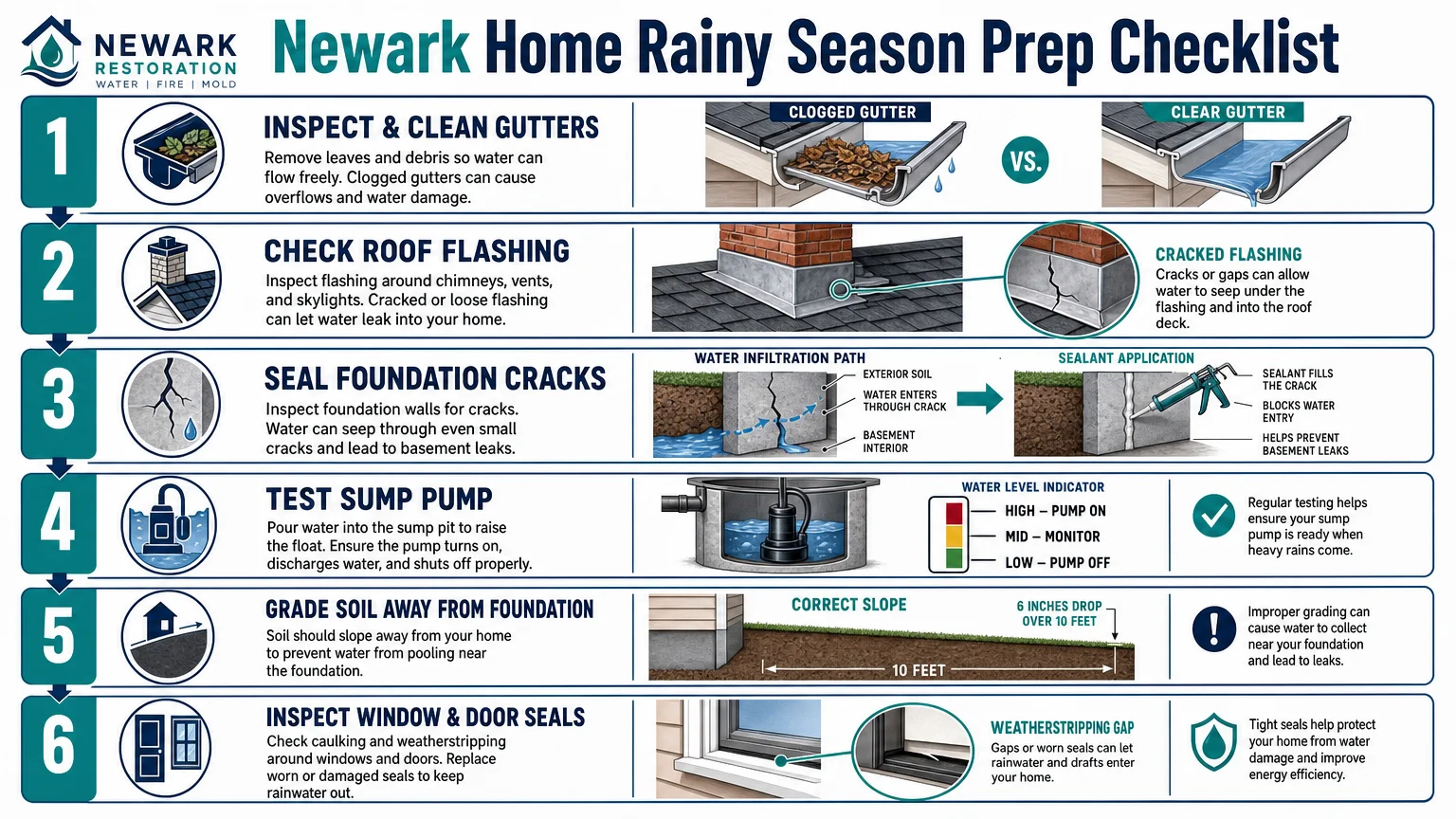
Gutters and Downspouts Gutters clogged with leaves and debris from summer and fall cannot channel water away from your roofline. Water that overflows from blocked gutters pools against your foundation and can work its way into crawl spaces and basements. Clean gutters thoroughly and confirm that downspouts extend at least four to six feet away from the foundation.
Roof Flashing and Shingles Cracked or lifted flashing around chimneys, skylights, and roof valleys is one of the most common causes of interior water intrusion. A visual inspection — or a professional roof assessment — before November can catch these vulnerabilities before they become active leaks.
Foundation and Grading The soil around your home’s perimeter should slope away from the foundation at a minimum grade of six inches over ten horizontal feet. If soil has settled flat or toward the house, re-grading in the fall prevents water from pooling against the foundation wall. Visible cracks in the foundation should be sealed with hydraulic cement or an appropriate waterproofing compound.
Window and Door Seals Weatherstripping and caulking around windows and exterior doors degrade over time. Gaps as small as a few millimeters allow wind-driven rain to penetrate, particularly during the high-velocity storms common to the Bay Area in winter.
| Exterior Check | Frequency | Warning Sign |
|---|---|---|
| Gutter cleaning | Every fall | Overflow during rain |
| Roof flashing inspection | Annually | Staining on interior ceilings |
| Foundation crack check | Annually | Efflorescence (white mineral deposits) |
| Downspout extension | Every fall | Water pooling near foundation |
| Window/door caulking | Every 2–3 years | Drafts or visible gaps |
How Should You Prepare the Interior of Your Newark Home?
Interior preparation is equally important and often overlooked until a problem is already underway. The goal is to ensure that if water does find a way in, your home’s systems are ready to manage it and you can respond quickly.
Sump Pump Testing If your Newark home has a basement or crawl space with a sump pump, test it before the first major storm. Pour water into the pit to confirm the float activates and the pump discharges properly. Consider a battery backup unit — power outages frequently accompany the same storms that drive the heaviest rainfall.
Water Heater and Appliance Hoses Washing machine supply hoses and water heater connections are common sources of sudden indoor flooding. Inspect hoses for bulging, cracking, or corrosion and replace any that show wear. Braided stainless steel hoses are significantly more durable than standard rubber.
Know Your Main Shutoff Every adult in your household should know where the main water shutoff valve is located and how to operate it. In a burst pipe or appliance failure scenario, shutting off the water supply within the first few minutes can mean the difference between a minor cleanup and a major restoration project.
What Should You Do If Water Enters Your Home During a Storm?
Speed is the defining factor in water damage outcomes. When water intrudes — whether through a roof leak, foundation seepage, or a failed sump pump — the first 24 to 48 hours determine how extensive the damage becomes.
Immediate Steps:
- Stop the source if possible (shut off water supply, cover the breach temporarily).
- Remove standing water using towels, a wet/dry vacuum, or a mop for small amounts.
- Move furniture, rugs, and personal items out of the affected area.
- Contact a professional water damage restoration service — emergency water extraction in Fremont and Newark is available 24/7 through Fremont Restoration Experts.
- Document the damage with photos before any cleanup begins, for insurance purposes.
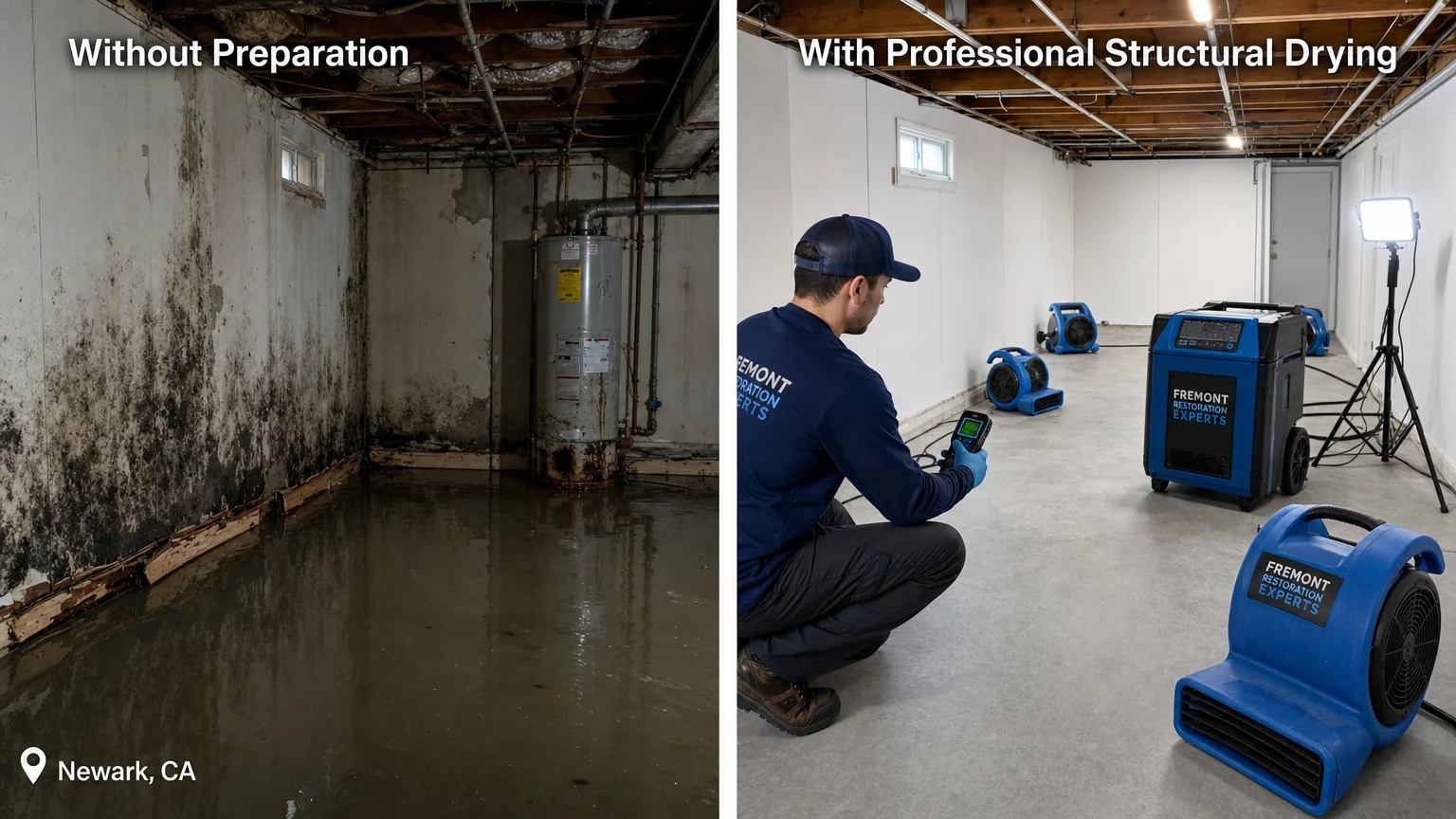
Do not use standard household fans as a substitute for professional drying equipment. Residential fans move surface air but do not address moisture trapped within wall cavities, subfloor assemblies, or insulation. Incomplete drying is the primary reason mold develops after a water event — often invisibly, inside walls.
If you notice musty odors, discoloration on walls, or unexplained allergy symptoms in the weeks following a water event, a professional mold inspection in Fremont can determine whether secondary damage has occurred.
How Does Professional Structural Drying Differ from DIY Drying?
Professional structural drying uses commercial-grade dehumidifiers, air movers, and moisture meters to extract water from building materials at a rate that household equipment simply cannot match. Technicians take moisture readings at multiple points — inside wall cavities, beneath flooring, within ceiling assemblies — to confirm that drying is complete before equipment is removed.
This matters because wood framing that retains moisture above a certain threshold will eventually support mold growth, even if the surface appears dry. The difference between professional and DIY drying is not cosmetic; it is structural.
Fremont Restoration Experts provides structural drying services across Newark and the surrounding East Bay communities, including Union City, San Lorenzo, and Castro Valley. For homeowners who have experienced previous water events, a review of past damage areas is worthwhile — water tends to find the same pathways repeatedly.
Is Mold a Realistic Risk After Rainy Season Water Intrusion?
Yes — and it develops faster than most homeowners expect. Under the right conditions (moisture, organic material, moderate temperatures), mold colonies can begin forming within 24 to 72 hours of a water event. Newark’s mild winters mean that temperatures rarely drop low enough to inhibit mold growth, even in January and February.
The risk is highest in areas with limited airflow: crawl spaces, wall cavities behind exterior walls, and beneath flooring. If your home has experienced any water intrusion this season — even a minor leak that appeared to dry on its own — it is worth having a professional assessment.
Fremont Restoration Experts offers mold remediation services for confirmed mold issues, as well as mold testing and inspection for homeowners who want to verify their home’s status after a wet season. For Castro Valley neighbors dealing with similar concerns, mold remediation in Castro Valley follows the same professional standard.
What Does a Rainy Season Prep Timeline Look Like for Newark Homeowners?
| Timeframe | Action |
|---|---|
| September–October | Clean gutters, inspect roof flashing, re-caulk windows and doors |
| October–November | Test sump pump, inspect appliance hoses, check foundation grading |
| November (first storm) | Confirm all exterior drains are clear, verify sump pump is operational |
| During storms | Monitor basement/crawl space, check attic for signs of roof leaks |
| After any water event | Contact restoration professional within 24 hours if intrusion occurs |
Protecting Your Newark Home Is a Year-Round Commitment
Rainy season prep and protecting your Newark home from water damage is most effective when it begins before the first storm — not during one. A few hours of exterior inspection and maintenance each fall, combined with tested interior systems and a clear emergency plan, significantly reduces the likelihood of a costly water event.
When prevention is not enough and water does enter your home, fast professional response makes all the difference. Fremont Restoration Experts is ready to assist Newark homeowners with emergency water extraction, structural drying, and mold remediation — 24 hours a day, seven days a week.
Ready to protect your home before the next storm? Contact Fremont Restoration Experts today for a professional assessment or to discuss your rainy season preparedness plan. Visit our FAQ page for more answers to common water damage questions, or learn more about our team and approach.
Frequently Asked Questions
How much does water damage restoration typically cost in Newark, CA?
Costs vary significantly based on the extent of damage, affected square footage, and whether mold remediation is required. Minor water events may involve a few hundred dollars in extraction and drying, while major flooding affecting structural components can reach into the thousands. Getting a professional assessment early limits the scope — and the cost — of restoration.
Can I file a homeowner's insurance claim for rainy season water damage?
Most standard homeowner's insurance policies cover sudden and accidental water damage, such as a burst pipe or roof leak, but may exclude gradual damage or flooding from external sources. Review your policy carefully and document all damage thoroughly before cleanup begins. A restoration professional can help you understand what documentation insurers typically require.
How quickly should I call a restoration company after water enters my home?
Contact a professional as soon as possible — ideally within a few hours of discovering the intrusion. The 24 to 48-hour window is critical for preventing mold growth and minimizing structural damage. Fremont Restoration Experts is available 24/7 for emergency water extraction in Newark and surrounding areas.
What is the difference between water mitigation and water restoration?
Mitigation refers to the immediate steps taken to stop damage from progressing — extraction, drying, and containment. Restoration refers to the repair and rebuilding work that returns the home to its pre-damage condition. Both phases are typically handled by the same restoration company for continuity.
Does rainy season water damage always lead to mold?
Not always, but the risk is significant if moisture is not fully removed within 24 to 72 hours. Mold requires moisture, organic material (like wood or drywall), and moderate temperatures — all of which are present in most water-damaged areas of a home. Professional drying that achieves target moisture levels is the most reliable way to prevent mold development.
What areas does Fremont Restoration Experts serve near Newark?
Fremont Restoration Experts serves Newark and the surrounding East Bay communities, including Fremont, Union City, San Lorenzo, Castro Valley, and Milpitas. Emergency services are available 24/7 across all service areas.
Are there signs of hidden water damage I should look for after a storm?
Yes. Watch for bubbling or peeling paint, soft spots in flooring, musty odors, visible staining on ceilings or walls, and unexplained increases in humidity indoors. These can indicate water trapped within building materials. For a detailed breakdown, see [5 signs your Castro Valley home has hidden water damage](/5-signs-your-castro-valley-home-has-hidden-water-damage-fremont) — the same warning signs apply to Newark homes.
Jason Bourne is the owner of a Fremont-based water restoration business, dedicated to helping homeowners and businesses recover quickly from water damage. With a focus on reliable service, fast response times, and quality restoration work, Jason is committed to helping clients restore their properties and get back to normal.